
SOUNDPROOFING VS SOUND ABSORPTION IN OFFICES
Soundproofing and sound absorption are different acoustic strategies that solve different problems, and confusing them is the most common reason office acoustic projects fail.
Soundproofing blocks sound from passing between spaces. It relies on mass, sealing, and decoupling, and its performance is measured by Sound Transmission Class (STC) - a higher STC means more sound is blocked between rooms.
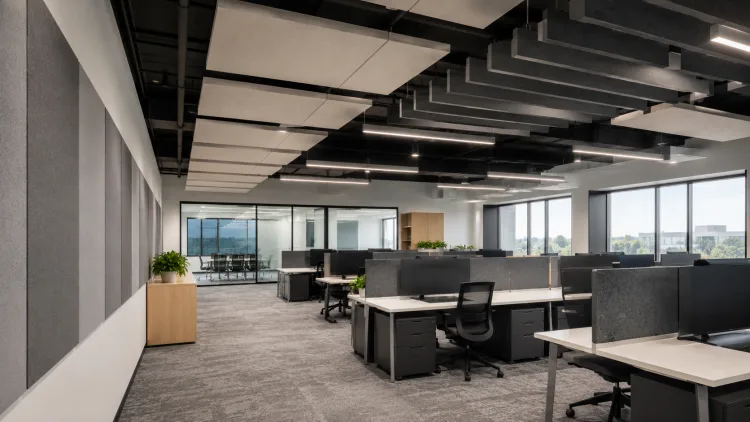
Sound absorption reduces echo and reverberation within a single space. It relies on soft, porous materials such as acoustic panels and baffles, and its performance is measured by Noise Reduction Coefficient (NRC) on a 0 to 1 scale - a higher NRC means more sound is absorbed inside the room.
Absorption alone does not stop sound from traveling between rooms. Adding acoustic panels to a wall reduces echo in that room but does little to keep a conversation from being heard next door, which requires blocking.
Most offices need both. Enclosed offices and conference rooms need blocking (STC) for privacy, while open-plan floors need absorption (NRC) and often sound masking to control the overall noise level.